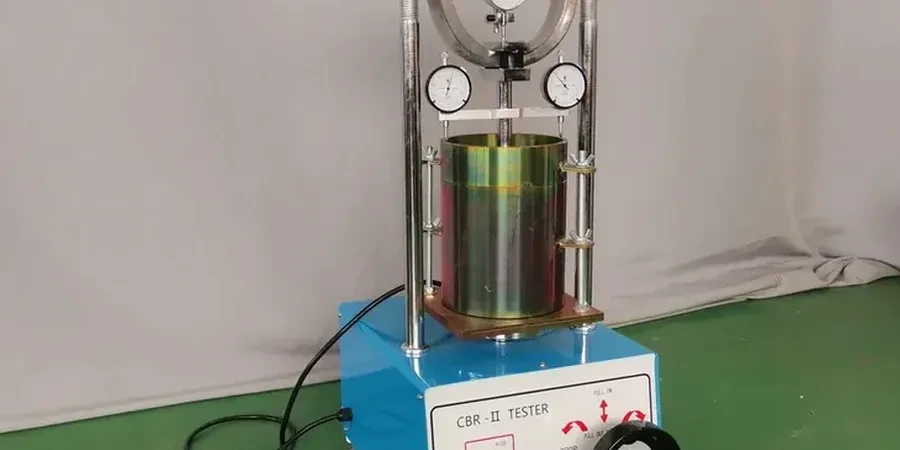
The loading press hums at a steady 0.05 inches per minute while the proving ring dial ticks upward. In our lab just outside the Beltway corridor, the California Bearing Ratio test starts with a compacted soil specimen submerged in a soak tank for 96 hours — exactly as the procedure demands for the high-water-table conditions common in the District. We prepare remolded samples at optimum moisture from modified Proctor curves, then measure penetration resistance against a standard crushed-stone reference. The operator logs readings at 0.1-inch intervals up to 0.5 inches, correcting for surface irregularities when the curve needs a zero-point adjustment. For projects near the Anacostia River floodplain, where subgrade saturation is a year-round reality, we run both soaked and unsoaked CBR values so the pavement engineer gets the full picture before specifying the structural number. This test is often paired with a grain-size distribution to verify fines content, especially when dealing with the silty deposits left by historic creek realignments downtown. For flexible pavement sections on collector streets, we frequently combine CBR data with rigid pavement subgrade modulus correlations when the design calls for concrete alternatives under heavy bus traffic.
A soaked CBR of 3 or below changes the entire pavement section — and in DC's reclaimed floodplain soils, that number shows up more often than designers expect.
Technical details of the service in Washington DC
Risks and considerations in Washington DC
The L'Enfant Plan of 1791 laid out grand avenues over tidal creeks that nobody talks about anymore — Tiber Creek, James Creek, Slash Run — all buried in brick sewers and covered with fill during the 19th century. When a contractor excavates for a new mixed-use building on H Street NE or a school expansion in NoMa, they often hit that old fill layer 8 to 15 feet down. The material is a grab bag: demolition rubble, dredged river silt, ash, and occasional timber cribbing. A CBR test run on this stuff without proper soaking gives a false sense of security. We have seen unsoaked values read 8% or 10% that drop below 2% after saturation, because the fines fraction turns to slurry when the water table rises after a heavy rainy season. The real risk is underdesigning the pavement section and ending up with rutting, alligator cracking, and base course contamination within two years of opening. For roadway projects funded through DDOT or the Federal Highway Administration, a failed pavement is not just a maintenance headache — it triggers traffic disruptions on streets already operating at capacity. The flexible pavement design procedure in the AASHTO 1993 Guide depends entirely on a reliable CBR input, and using the wrong value costs orders of magnitude more than the lab test itself. We also see risk when contractors try to reuse on-site soils without verifying the CBR after compaction — a material that passes a visual classification can still fail structurally once traffic loads are applied.
Our services
Our lab supports pavement design across the District with a focused set of testing services that feed directly into the structural design process:
Soaked and Unsoaked CBR
We compact specimens at optimum moisture content per ASTM D1557, soak them for 96 hours with surcharge weights matching the design pavement section, and measure penetration resistance at 0.1-inch intervals. Both corrected CBR values are reported, along with swell percentage during soaking — critical for expansive subgrades found in DC's residual soils north of the fall line.
CBR with Companion Soil Classification
Every CBR specimen gets a full index property workup: grain-size distribution by sieve and hydrometer, Atterberg limits, and USCS classification per ASTM D2487. We flag materials with plasticity indices above 20 because they tend to lose significant strength when saturated — a common scenario in the District's alluvial deposits.
Pavement Section Correlation
We provide CBR-to-resilient modulus correlations using the AASHTO 1993 Guide and NCHRP 1-37A methodologies, so the pavement designer can directly input our lab results into structural number calculations for flexible and rigid pavement alternatives.
Quick answers
How much does a laboratory CBR test cost per specimen?
A single-point CBR test with compaction and 96-hour soaking runs between US$120 and US$200 per specimen, depending on whether we also run companion Atterberg limits and grain-size analysis. Most pavement investigations require at least three specimens (one per soil type encountered), so a typical project comes in at US$360 to US$600 for the full CBR data set.
Why does the CBR test require a 96-hour soaking period?
The four-day soak simulates the worst-case moisture condition the subgrade will experience over the pavement's service life. In Washington DC, where the water table is often within a few feet of the surface and seasonal precipitation keeps soils near saturation, the soaked CBR value is the one that governs pavement design. Skipping the soak gives unrealistically high numbers that lead to underdesigned sections.
What CBR value is considered acceptable for a residential street in DC?
DDOT typically requires a minimum soaked CBR of 3% to 5% for local residential streets, but the actual target depends on traffic loading, the pavement structural number, and whether the subgrade will be stabilized. We have seen projects where lime or cement treatment was specified after our lab reported soaked CBR values below 2% on organic silts near the Anacostia River corridor.
Can you run a CBR test on aggregate base course material?
Yes, we test both subgrade soils and unbound base course aggregates. For granular base materials, the specimen preparation differs: we compact at the moisture content expected during construction, and the soaking procedure may be modified if the base layer drains freely. The CBR of a properly compacted crushed stone base in DC typically exceeds 80%.