Foundation design errors in the District don't just crack slabs — they trigger adjacent property claims that can stall a project for months. We see it repeatedly in Capitol Hill rowhouse renovations where a shallow mat foundation wasn't keyed below the fill layer, and differential settlement cracked a party wall. Washington DC sits on Cretaceous-age Potomac Group clays, silts, and sands overlain by up to 15 feet of uncontrolled fill from 19th-century grading. The water table at 5 to 12 feet bgs adds a buoyancy and softening dimension that a generic prescriptive mat cannot handle. A properly engineered raft foundation distributes column and wall loads across a continuous rigid slab, reducing total and differential settlement to tolerable limits. We size the mat thickness, reinforcement, and subgrade preparation using site-specific stratigraphy from SPT borings and lab index testing, not just a presumptive bearing pressure from a table. For deeper compressible lenses, we integrate CPT testing to capture thin silt seams that SPT spoon recovery alone might blur.
A mat foundation on Potomac Group soils works when the design springs from the site's modulus profile — not from a default bearing table.
Technical details of the service in Washington DC
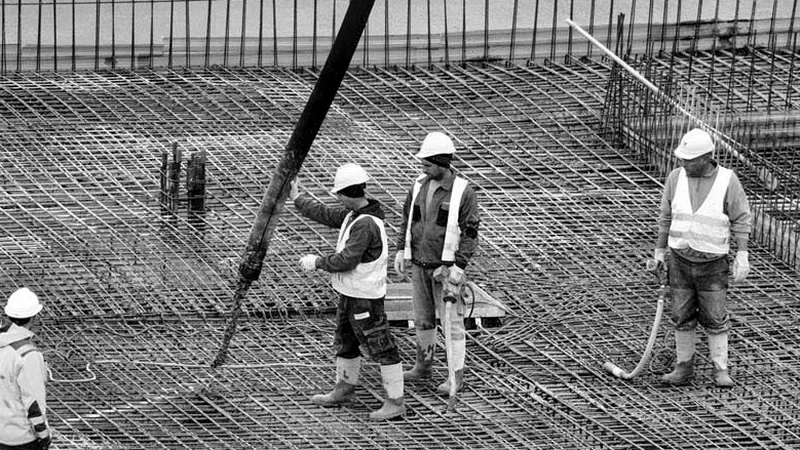
Field demonstration
Risks and considerations in Washington DC
The District's buildable land is a palimpsest of filled valleys and rerouted creeks. Tiber Creek and James Creek were buried in the 1870s and 1890s, and their former alignments — now under Constitution Avenue and parts of Capitol Hill — carry thick, poorly compacted fill with decayed organics and debris. When a developer inherits a lot in these corridors, a mat foundation designed without knowing the fill bottom risks long-term settlement that can tilt a six-story building by a quarter inch over five years. The L'Enfant Plan grid and its later extensions placed deep basements and vaults under many commercial blocks, and undocumented vault backfill often extends below the sidewalk line. We cross-reference Sanborn maps and early USGS quadrangles before finalizing the mat geometry. Buoyancy is the other quiet threat: with the water table perched at 8 feet in the Federal Triangle area, a mat with insufficient dead load or without pressure-relief detailing can experience uplift during a 48-hour storm event that overloads the combined sewer system. The IBC 1805.3.1 uplift check isn't academic here — it is survival for any raft foundation with a basement level.
Our services
Our scope for a raft foundation project in Washington DC starts with the ground model and runs through the reinforcement schedule, with intermediate deliverables that align with the phased permitting process at the Department of Buildings.
Geotechnical investigation for mat design
SPT borings logged by a licensed geotechnical engineer, laboratory classification (Atterberg limits, grain size, moisture content), and bearing capacity recommendations per IBC 1806 for the specific mat footprint.
Structural raft analysis and detailing
Finite element or Winkler spring analysis of the mat slab including column punching shear checks, flexural reinforcement layout, and construction joint detailing per ACI 318.
Construction-phase subgrade verification
Proof rolling observation, plate load testing on the prepared subgrade, and compaction testing of any engineered fill placed below the mat to confirm the design modulus and bearing values.
Quick answers
What is the typical cost for a raft foundation design in Washington DC?
For a residential or small commercial mat foundation in the District, the engineering design package — geotechnical investigation, structural raft analysis, and stamped drawings — typically falls between US$1.130 and US$4.040 depending on the building footprint, number of borings, and complexity of the ground profile.
When is a raft foundation better than isolated footings in DC soil?
A mat becomes the better choice when the allowable bearing pressure is below 2,500 psf, when column spacing is tight, or when the site has a history of fill and the total settlement under isolated footings would exceed the 1-inch limit. It also works well where the water table is high and a continuous slab can act as a barrier with proper waterproofing.
Does DC code require a specific factor of safety for mat foundations?
The IBC 2015 adopted by the District requires a minimum factor of safety of 3.0 against bearing capacity failure for mat foundations designed by a registered design professional. We also follow ASCE 7-22 load combinations for the strength and serviceability checks.
How do you handle mat foundations on uncontrolled fill in the District?
We map the fill thickness with SPT borings and, if it exceeds 5 to 8 feet, we either remove and recompact it under observation or design a stiffened raft with downstand beams that bear below the fill. In some cases, ground improvement with vibrocompaction or stone columns is used before placing the mat.
How long does the design and approval process take in Washington DC?
A typical timeline runs four to six weeks from the first site visit to the stamped drawing set ready for DOB submission, assuming no unexpected soil conditions. The field investigation takes one to two days, the lab program about two weeks, and the structural analysis and detailing another two to three weeks. DC DOB structural plan review adds its own processing time depending on the intake queue.