The soil conditions between Capitol Hill and the National Mall can differ enough to change a building's entire seismic response. On the Hill, shallow rock and dense Pleistocene deposits provide a stiff foundation. Down toward the Mall and Southwest Waterfront, artificial fill over soft Potomac River sediments creates a completely different dynamic for earthquake loading. That contrast matters when you are designing a building meant to stay operational after a major event. Base isolation becomes the logical path for critical structures in Washington DC where post-earthquake functionality is non-negotiable. Our team has worked on isolation retrofits for federal buildings where the bearing must handle both seismic displacement and the District's high water table, often integrating the isolation plane with waterproofing details that the local geology demands. We combine the CPT test data from the softer riverine zones with site-specific ground motion models to size lead-rubber or friction pendulum bearings that match the actual subsurface profile, not just a generic code spectrum.
An isolated building on DC's soft soils can reduce story drifts by 60 to 80 percent compared to a fixed-base design, keeping the structure operational when it matters.
Technical details of the service in Washington DC
Risks and considerations in Washington DC
A 10-story office building on Constitution Avenue proceeded with a conventional fixed-base design because the structural engineer assumed rock at 40 feet. The borings stopped there. During excavation, a 15-foot lens of soft organic silt appeared directly under the core, missed entirely by the initial investigation. The resulting fixed-base period shifted into resonance with the site's predominant period, and the drift ratios exceeded code limits. The fix cost the owner an 8-month redesign and a foundation retrofit that doubled the concrete volume. With base isolation, that same soft layer becomes less of a threat because the superstructure decouples from ground motion amplification. In Washington DC, where the seismic hazard is moderate but the consequence of downtime is extreme, the cost of not verifying subsurface conditions properly can exceed the isolation system premium by a factor of three once operational losses are counted. We have seen this pattern repeat across projects near the Anacostia River corridor and in the Navy Yard redevelopment zone.
Our services
Our base isolation design services in Washington DC cover the full project lifecycle, from feasibility analysis through construction oversight and long-term monitoring plans.
Isolation System Selection & Modeling
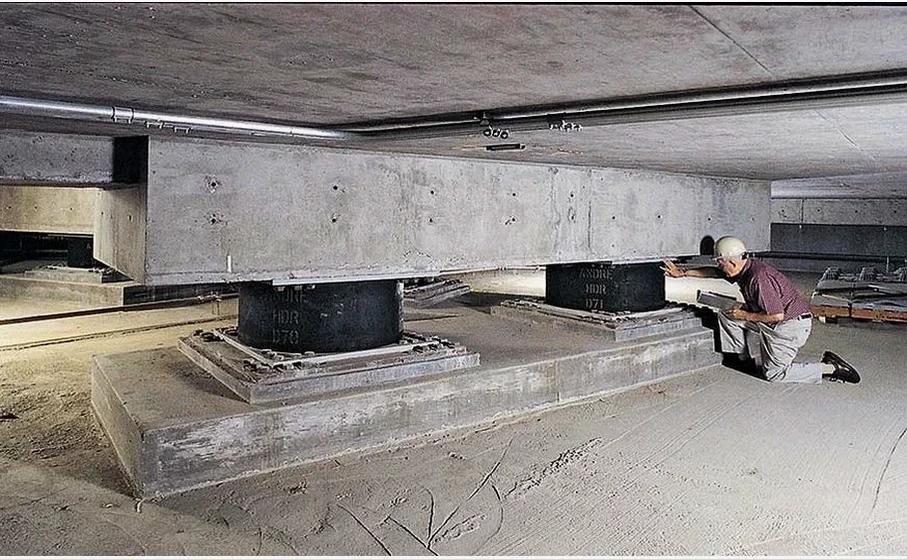
Comparative analysis of lead-rubber bearings, high-damping rubber bearings, and triple friction pendulum systems using nonlinear time-history analysis to match the District's seismic hazard level.
Peer Review & ASCE 7 Compliance
Independent design review following ASCE 7-22 Chapter 17 requirements, including prototype bearing testing protocols and peer review panel coordination.
Retrofit Isolation for Historic Structures
Isolation plane design integrated with existing foundations of masonry and steel-frame buildings, preserving historic fabric while achieving Risk Category IV performance objectives.
Construction-Phase Testing & Inspection
On-site bearing installation verification, moat wall detailing review, and isolation interface coordination with mechanical and plumbing systems.
Quick answers
Is base isolation worth the cost for a mid-rise building in a moderate seismic zone like DC?
The answer depends on the building's function and downtime tolerance. For a standard residential project, probably not. For a data center, hospital, or federal operations center where 30 days of closure costs more than the isolation system, the calculus flips. The isolation premium typically runs between US$4,270 and US$8,060 per isolator for the bearing hardware and testing, plus the moat wall and isolation joint costs. On a 150,000-square-foot building with 40 isolators, the incremental structural cost is often recovered through reduced superstructure steel tonnage and avoided architectural damage repairs over the building's life.
How does the high water table in DC affect base isolation design?
The shallow groundwater in much of the District, particularly south of Pennsylvania Avenue, means the isolation pit functions as a permanent below-grade enclosure. We design the moat wall as a watertight reinforced concrete box with continuous waterproofing and sub-slab drainage. The isolators themselves are specified with stainless steel shim plates and corrosion protection suitable for high-humidity environments. Access for inspection after a flood event must be integrated into the moat layout.
What peer review requirements apply to base isolation projects in Washington DC?
ASCE 7-22 Chapter 17 mandates an independent peer review for all seismically isolated structures. The review panel must include at least one member with documented base isolation project experience. The review covers ground motion selection, bearing mechanical properties, prototype test results, and the nonlinear analysis model. For federally funded projects in DC, additional review through the Interagency Committee on Seismic Safety in Construction (ICSSC) may apply depending on the agency.
Can you isolate an existing historic masonry building without damaging the facade?
Yes, but it requires a surgical approach. We typically install a temporary steel needle beam system above the isolation plane, transfer the building load to temporary supports, cut the walls and columns at the isolation plane, and insert the bearings. The cut line is often concealed behind a belt course or water table detail. We have done this on unreinforced masonry buildings in the District's historic districts where the exterior appearance could not be altered. Vibration monitoring during the cut phase is essential to avoid distress to brittle finishes.