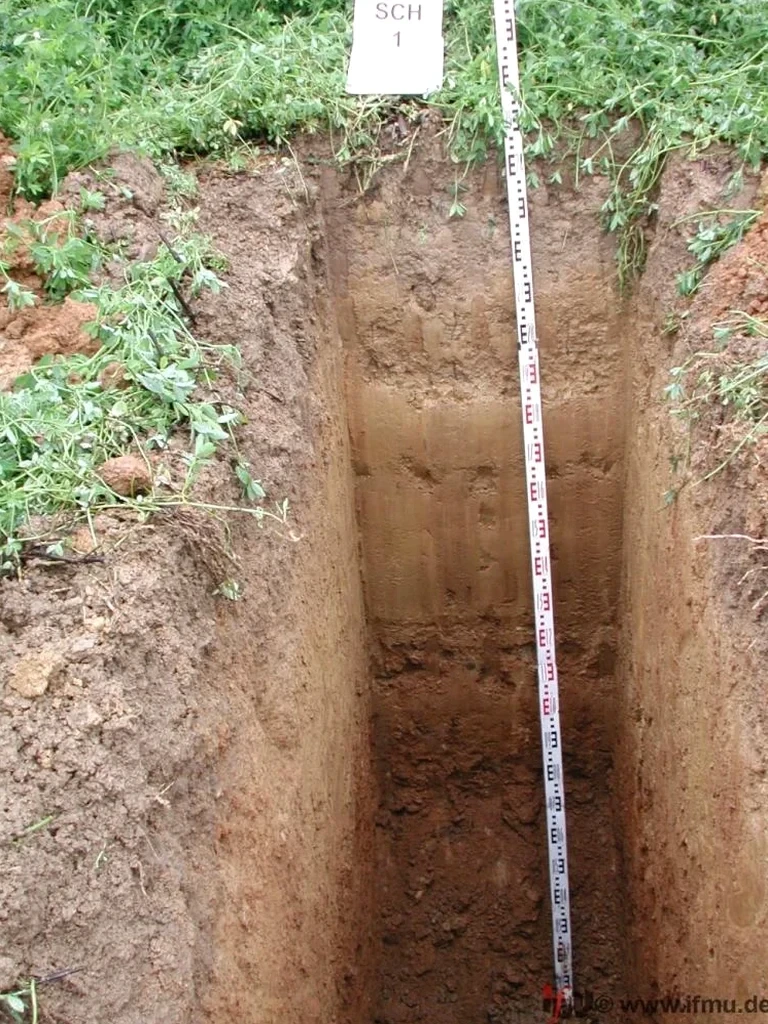
Washington DC sits at an elevation of roughly 410 feet above sea level, straddling the Fall Line where the Piedmont Plateau meets the Atlantic Coastal Plain. This abrupt geological transition means subsurface conditions change dramatically within a single city block—weathered rock in the northwest can give way to compressible alluvium just a few thousand feet southeast. For projects in the District, an exploratory test pit delivers what boreholes alone cannot: direct visual access to the soil profile. It allows our team to identify fill thickness, observe moisture conditions, and extract undisturbed samples at precise depths. When a new embassy compound in Northwest required verification of residual soils derived from the Wissahickon Schist, we combined test pits with laboratory index testing to confirm bearing assumptions before footing dimensions were finalized.
Direct observation of soil fabric, moisture, and fill composition reduces the uncertainty that even the best borehole log cannot eliminate.
Technical details of the service in Washington DC
Risks and considerations in Washington DC
We investigated a six-story mixed-use building on H Street NE where the contractor assumed natural ground at 4 feet based on GPR scans alone. The test pit revealed 9 feet of uncontrolled fill containing brick rubble, timber scraps, and buried organic silt—material that would have triggered differential settlement exceeding 1.5 inches across the mat. In DC, the IBC requires fill to be identified and properly compacted or removed before structural loads are applied; skipping direct visual verification leaves you exposed to change orders, foundation redesigns, and stop-work notices from DCRA inspectors. Another common scenario: discovering utility conflicts inside the excavation zone that as-built drawings missed. A test pit catches these problems when corrections cost thousands, not hundreds of thousands.
Our services
Every exploratory test pit in DC is logged by a senior field geologist who understands the local geology. Our service package includes the physical excavation, in-situ logging, sampling, and a concise interpretive report.
Standard test pit investigation
Mechanical excavation to target depth, OSHA-compliant shoring or benching, detailed log per ASTM D2487, bulk and Shelby tube sampling, and a summary letter with bearing capacity estimates for shallow foundations.
Combined test pit and SPT correlation program
Paired test pits and SPT borings at the same location to calibrate N-values against observed soil behavior—particularly useful in the mixed Coastal Plain deposits of Southeast DC where blow counts can misrepresent silt behavior.
Quick answers
What does an exploratory test pit cost in Washington DC?
For a standard pit reaching 12 to 15 feet depth, including excavation, logging, sampling, and the interpretive report, expect a range of US$550 to US$740 per pit. Variables include access constraints, pavement saw-cutting, traffic control if the pit is in the right-of-way, and the need for hydraulic shoring in deeper or unstable ground.
How deep can you go and do you need a permit?
We routinely excavate to 15 feet; deeper is possible with trench boxes. In DC, any excavation over 5 feet requires a permit from DCRA and compliance with OSHA Subpart P for protective systems. We handle the permit application as part of our scope, but approval timelines depend on the review queue.
How does a test pit compare to a soil boring?
A boring gives you a 2-inch diameter sample; a test pit gives you a full wall profile. You can see stratification, lenses, fissures, and fill inclusions that are easily missed in a split spoon. The trade-off is depth—borings go deeper, pits stop where groundwater or stability dictates. In DC we often use both: pits for the upper 15 feet and borings for deeper bearing layers.
What safety measures do you follow during excavation?
All our pits comply with OSHA 29 CFR 1926 Subpart P. That means sloping, benching, or trench boxes depending on soil type and depth. A competent person inspects the excavation daily and after any rain event. We also maintain DC One Call clearance for underground utilities before breaking ground.