Washington DC sits squarely on the Atlantic Coastal Plain, where the Potomac and Anacostia rivers have deposited complex layers of soft organic silts, stiff clays, and loose alluvial sands. What looks like stable ground on a site walk can be a profile that drains poorly and compresses unevenly under load. When we run a grain size distribution test on a split-spoon sample from 25 feet down, we often find a gap-graded mix that explains differential settlement before the structural engineer even asks. The grain size analysis combining mechanical sieving and a hydrometer test gives us the full curve, from gravel down to the colloidal fraction, and that curve dictates everything—drainage design, compaction specs, frost protection, and whether the native soil can serve as fill or needs to be replaced. In a city where building height is limited by Congress and developers push deep into the Potomac formation, skipping this test is a liability. To correlate grain size with in-situ density, we often pair the lab work with a sand cone density test during backfill inspection.
The percentage passing the No. 200 sieve is the single most important number for a DC foundation, because it defines whether you are dealing with a free-draining soil, a frost-susceptible silt, or a high-plasticity clay.
Technical details of the service in Washington DC
Risks and considerations in Washington DC
The District of Columbia Building Code Supplement references the IBC and ASCE 7, which require soil classification as a prerequisite for seismic site class determination. Washington DC sits in a moderate seismic hazard zone with a long-period ground motion risk amplified by the deep Coastal Plain sediments. If a grain size analysis is omitted or performed on an unrepresentative sample, the geotech may assign an incorrect site class, leading to an under-designed lateral system. We have reviewed reports where a contractor classified a silty sand as a clean sand simply because they eyeballed the bag, and the resulting foundation had to be retrofitted with additional grade beams after the first heavy rain exposed the drainage problem. The hydrometer portion of the test is critical here—those fine particles control liquefaction susceptibility in a seismic event, even in DC. Running the full curve protects the owner from a structural failure that insurance will not cover if the investigation was deemed noncompliant with code.
Our services
We run the full grain size curve in our accredited District laboratory, with results that integrate directly into the geotechnical baseline report. Every sample is split, oven-dried, and processed by a technician who knows the difference between a silty sand from the Potomac Formation and an artificial fill from a razed block in Shaw.
Sieve Analysis (Coarse & Fine Fraction)
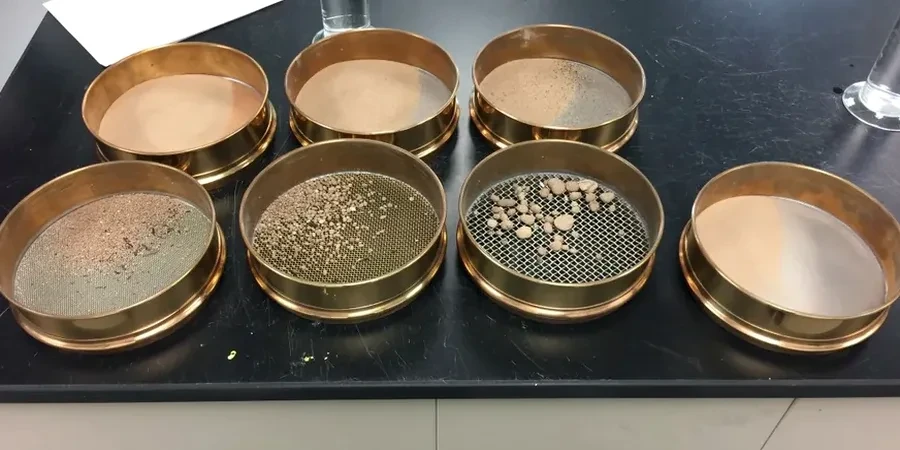
Mechanical shaking through a column of sieves from 3 inches down to No. 200 under ASTM D6913. We calculate the coefficient of uniformity (Cu) and coefficient of curvature (Cc) to assess gradation—critical for filter design, drainage media, and backfill specification compliance.
Hydrometer Analysis (Sedimentation)
For the minus-75-micron fraction, we run a hydrometer test per ASTM D7928 to define the silt and clay distribution. This separates an ML from a CL and gives the clay-size percentage that controls cohesion, permeability, and long-term consolidation settlement.
Quick answers
How much does a grain size analysis cost for a single sample in the Washington DC area?
A standard sieve plus hydrometer package for one sample typically runs between US$90 and US$200, depending on whether you need the full hydrometer curve or just the minus-200 wash. Volume pricing kicks in for multi-borehole programs, which is common on larger projects in NoMa or Navy Yard.
How long does it take to get grain size results from the lab in DC?
Standard turnaround is three to five business days. The hydrometer portion takes the longest because the sedimentation readings run over a 24-hour period at minimum. Rush service can get you a preliminary USCS classification in 48 hours when the foundation contractor is waiting to mobilize.
Do you need a hydrometer test or is a sieve analysis enough?
If the material is a clean sand or gravel with less than 5% fines, a sieve-only analysis is usually sufficient. For the silts and clays common in the Potomac and Anacostia floodplain deposits around the District, the hydrometer is essential to quantify the clay fraction and assign the correct USCS group symbol.
What sample size do you need from the field to run a full grain size distribution?
For fine-grained soils like the clays found in the DC area, we need about 500 grams of material in a sealed bag. For granular samples with gravel, we prefer at least 5 kilograms to ensure the coarse fraction is representative. The field logger should note any cobbles or boulders that would not fit in the sample jar.