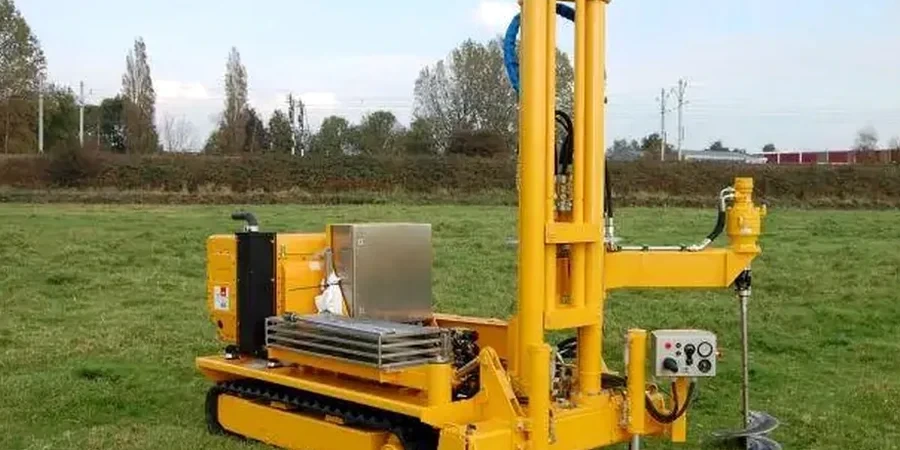
The 20-ton CPT truck positions over the test point, hydraulic rams push against its mass to advance the cone at 2 cm/sec — that's the standard rate per ASTM D5778 — and the cone's tip resistance, sleeve friction, and pore pressure register on the cabin monitors every centimeter. In Washington DC, where the terrain shifts from Pleistocene terrace deposits in Northwest to artificial fill over organic silts along the Anacostia River, we mobilize tracked CPT rigs when truck-mounted units can't access tight urban lots. The District's geology, shaped by the Fall Line that separates the Piedmont bedrock from the Coastal Plain, demands a profiling tool that captures thin sand layers, soft clay lenses, and potential liquefiable strata without sample disturbance. Before designing foundations in areas like Navy Yard or NoMa, we recommend pairing the continuous CPT profile with a discrete SPT drilling program where split-barrel samples are needed for lab index testing.
A single CPT sounding in DC's Coastal Plain sediments replaces three to four SPT borings for stratigraphic profiling, cutting field time by half while delivering continuous data.
Technical details of the service in Washington DC
Risks and considerations in Washington DC
The most common mistake we see in DC projects is relying solely on SPT data for liquefaction assessment in the Coastal Plain sands. The standard SPT hammer energy can vary by 30% or more — even with an automatic trip hammer — while CPT measures tip resistance directly without energy correction factors. Per the IBC 2021 and ASCE 7-22, liquefaction triggering analyses using CPT data (per Boulanger & Idriss 2014) carry lower uncertainty and often reduce the required ground improvement depth compared to SPT-based methods. Another recurring error: stopping the CPT refusal on a thin gravel lens and calling it bedrock. The Potomac Formation contains discontinuous gravel stringers that can fool an inexperienced operator. We push through or pre-drill when refusal criteria (qc > 50 MPa sustained over 10 cm) suggest a genuine bearing stratum, not a cobble.
Our services
Our CPT services in Washington DC cover the full spectrum of cone penetration testing, from single-point soundings for small residential additions to multi-day campaigns with seismic CPT for high-rise foundations in the central business district. Each test is executed by operators trained on the Fugro-style digital cones we maintain and calibrate in-house.
Piezocone (CPTu) Profiling
Standard 10 cm² cone with pore pressure transducer at the u2 position. Continuous logs of qc, fs, and u2 with soil behavior type classification per Robertson charts. Typical push depths 20–35 m in DC's Coastal Plain.
Seismic CPT (SCPTu)
Piezocone plus a triaxial geophone module that records shear wave arrivals from a surface source. Provides Vs profiles every 1 m for site classification per IBC Chapter 20 and liquefaction analysis per ASCE 7-22.
Dissipation & Permeability Testing
Pore pressure dissipation tests at targeted depths in cohesive layers. Monitors u2 decay until 50% equilibrium is reached. Data processed to estimate coefficient of consolidation and in-situ hydraulic conductivity for dewatering design.
Quick answers
How much does a CPT sounding cost in Washington DC?
A standard CPTu sounding to 20–25 m depth in the District typically runs between US$190 and US$240 per linear meter, including mobilization within the Beltway, real-time data acquisition, and the final report with soil behavior type logs. Seismic CPT adds roughly 25–35% to the per-meter rate. The total cost depends on access conditions — tracked rigs for tight spaces carry a small premium — and whether traffic control plans are required for street work.
How deep can CPT push in DC soils?
In the Coastal Plain sediments that underlie much of downtown DC, east of Rock Creek Park, our 20-ton truck routinely reaches 30–35 m before refusal. In Northwest neighborhoods like Georgetown or Tenleytown, where the Piedmont saprolite and weathered schist are shallower, refusal often occurs between 8 and 18 m. We pre-drill through fill and cobble layers when the cone encounters early refusal that doesn't match the expected bedrock depth from USGS maps.
Can CPT replace all SPT borings on a DC project?
No — CPT cannot retrieve samples for lab testing, so a reduced number of SPT borings is still required for index properties (Atterberg limits, grain size) and strength tests. The District's building officials typically accept a program where CPT provides the continuous stratigraphy at close spacing, and SPT borings at wider spacing provide the samples. For liquefaction studies, CPT is preferred per ASCE 7-22, but for foundation design on cohesive soils, undisturbed Shelby tube samples from companion borings are still needed for consolidation and triaxial testing. More info.