Washington DC sits on the Atlantic Coastal Plain, a mix of Pleistocene terraces and deep Potomac Group clays that challenge any vertical cut beyond 15 feet. The water table here rises fast — sometimes within 8 feet of grade near the Anacostia River — and that changes everything for an excavation support system. Over the past decade, downtown projects have pushed basements to five levels in tight urban blocks flanked by unreinforced masonry buildings from the 1920s. A standard soldier pile wall won't cut it when you're within the zone of influence of a Metro tunnel or a historic landmark. The geotechnical design of deep excavations in this city demands more than a textbook approach: it requires pore pressure modeling tied to actual tidal fluctuations in the Potomac, plus a working knowledge of DCRA permit sequencing. Before the first yard of soil comes out, we define the lateral earth pressure envelope with site-specific parameters, not generic Ka values. For sites with layered fill over natural deposits, we often pair the excavation design with a CPT test campaign to map undrained shear strength continuously across the footprint.
In DC, a deep excavation design lives or dies by the pore water pressure assumption — get the phreatic surface wrong and the entire shoring sequence unravels.
Technical details of the service in Washington DC
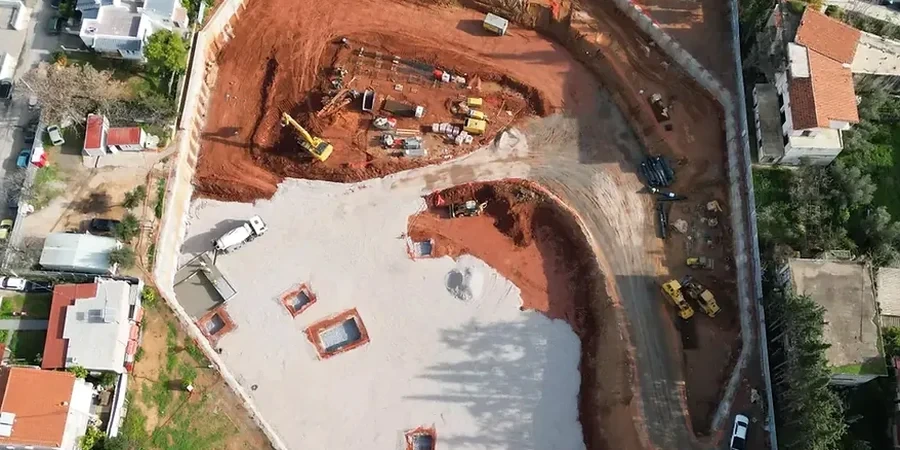
Field demonstration
Risks and considerations in Washington DC
On a recent downtown DC project, we deployed an inclinometer string inside a 60-foot soldier pile wall the day after the first 10-foot lift came out. By the time the excavation hit subgrade, the cumulative deflection at the wall's midpoint had reached 0.8 inches — right at the threshold that triggers a DCRA notification if adjacent buildings are within H/2 distance. The real risk in Washington DC isn't just wall collapse; it's differential settlement that cracks a century-old brick party wall and halts the job for six months of litigation. We mitigate this by specifying preloaded cross-lot struts within 24 hours of each lift, monitoring with automated total stations that update every 15 minutes, and maintaining a geotechnical engineer on-call who can authorize a strut load adjustment before the next morning's concrete pour. Dewatering-induced settlement beyond the excavation footprint is another silent hazard; we model drawdown cones with MODFLOW when the site sits within 500 feet of a tidal reach, because the hydraulic conductivity of the Patapsco aquifer can shift an order of magnitude between boreholes.
Our services
Our deep excavation design package covers the full lifecycle from concept through construction support, tailored to the permitting environment of the District.
Excavation Support Design & Peer Review
Complete shoring plans with soldier pile and lagging, secant pile, or diaphragm wall options. Includes DCRA-ready calculation packages with finite element output, strut and waler sizing, and staged excavation sequence drawings.
Construction-Phase Instrumentation & Monitoring
Automated monitoring plans with inclinometers, piezometers, and optical survey targets. We set action levels tied to specific construction triggers and provide weekly interpretation reports to the general contractor.
Quick answers
What is the typical cost range for a deep excavation design in Washington DC?
For a single-level basement excavation with standard soldier pile design, expect costs in the range of US$1,940 to US$3,200. Multi-level, braced excavations in tight urban blocks with finite element analysis and instrumentation planning typically run from US$4,500 to US$7,380, depending on the number of support levels and the complexity of adjacent structure protection.
How does the Potomac Group clay affect excavation stability?
The Potomac Group clays are overconsolidated but fissured, which means their drained strength can drop significantly over time as pore pressures equalize after cutting. We run both short-term (undrained) and long-term (drained) stability analyses and typically specify a shorter exposure window for the final cut before the permanent structure must provide lateral restraint.
What DC permits are required before starting a deep excavation?
You'll need a DCRA building permit with shoring and excavation plans sealed by a DC-licensed professional engineer. For excavations within 25 feet of a WMATA Metro tunnel or station, a separate WMATA right-of-entry and review is mandatory. Sites near historic districts also require a Mayor's Agent approval if the excavation could affect a contributing structure.
How do you handle dewatering in downtown DC where discharge restrictions apply?
DC Water limits discharge to combined sewers, so we design closed-loop treatment systems with settling tanks and pH adjustment when necessary. For sites with high TSS from silty Coastal Plain deposits, we specify bag filters rated to 10 microns before any water leaves the site, and we coordinate the discharge permit with DC Water's Industrial Waste Section early in the design phase.