Washington DC’s geology shifts fast: one site sits on solid Piedmont bedrock, the next on compressible Coastal Plain sediments near the Anacostia. That contrast, plus the District’s hot, humid summers and freeze-thaw cycles in winter, makes a soil mechanics study more than a formality — it’s the difference between a foundation that settles predictably and one that doesn’t. Our lab runs grain-size analysis and Atterberg limits on every project to classify the material exactly, while triaxial testing gives engineers the shear strength parameters they need for deep excavations near the Federal Triangle or embankment design along the Potomac. With a mean elevation of just 150 feet and a high water table in many neighborhoods, drainage behavior matters as much as bearing capacity.
In DC, the same soil mechanics study that satisfies IBC Chapter 18 also answers the question every lender asks: will this foundation perform?
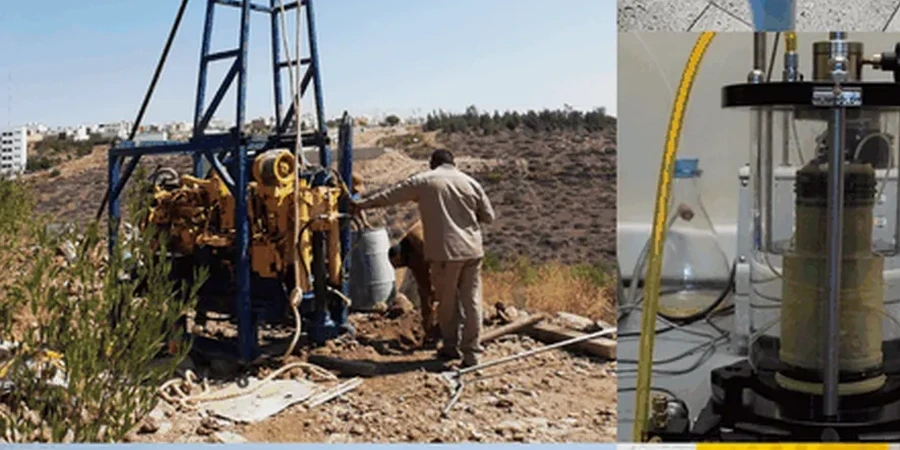
Technical details of the service in Washington DC
Risks and considerations in Washington DC
L’Enfant’s 1791 plan laid out avenues over creeks and swamps that were later filled, and a century of urban renewal added more artificial ground — the old Tiber Creek alignment under Constitution Avenue is just one example. A soil mechanics study that skips consolidation testing on those historic fills can miss a settlement problem until cracks appear in masonry party walls. The District’s seismic hazard is moderate but real: the Virginia Piedmont fault system and the 2011 Mineral earthquake reminded everyone that DC is in a region where long-period ground motion affects mid-rise structures. Liquefaction screening on saturated granular layers and slope stability analysis for the steep grades in Northwest DC neighborhoods like Mount Pleasant are routine parts of our scope when the subsurface data calls for it.
Our services
Our soil mechanics study in Washington DC covers the full chain from field investigation to lab report, structured around the project phase and the geotechnical question at hand.
Laboratory Testing Program
Classification, shear strength, and consolidation testing on Shelby tube and SPT samples, run in an ISO 17025-accredited lab. We deliver parameter sets ready for bearing capacity, settlement, and lateral earth pressure calculations.
Foundation and Earthwork Recommendations
Interpretative report with allowable bearing pressures, anticipated settlements, slab-on-grade support values, and compaction specifications. We address DCRA plan review comments directly.
Quick answers
What does a soil mechanics study in Washington DC typically cost?
For a standard scope combining field drilling, Shelby tube sampling, and lab testing (classification plus shear strength on 2–3 samples), the range runs from US$2,890 to US$5,210. The final figure depends on boring depth, number of samples, and whether consolidation or chemical testing is required.
How many borings does the District require for a soil mechanics study?
The IBC requires at least one boring per 1,600 square feet of building footprint for structures under 100 feet in plan dimension, with a minimum of two borings. The DCRA structural division expects borings to extend through all compressible strata or to a depth where the stress increase is less than 10% of the existing overburden pressure — often 30 to 60 feet in the Coastal Plain portions of the city.
How long does it take to get the lab results?
Standard classification tests (grain-size, Atterberg limits, moisture content) turn around in three to five business days. Consolidation and triaxial tests require longer — consolidation can take seven to ten days per sample because of the incremental loading schedule, and a CU triaxial set adds another seven days. We schedule the lab sequence so the classification data arrives first, letting the design team start while the strength and consolidation data follow.