Design a pile foundation in Anacostia versus one up near Tenleytown, and you’re dealing with two completely different soil profiles barely six miles apart. East of the Anacostia River you hit soft Potomac Group clays and loose alluvial sands that keep going for 60 feet or more; head northwest into the Piedmont uplands and decomposed schist saprolite sits right under a thin mantle of stiff residual silt. That contrast is why Washington DC pile foundation design can’t rely on a single presumptive bearing stratum. We pair deep borings with SPT drilling to map refusal depth block by block, then run consolidated-undrained triaxial tests on undisturbed samples so the shaft friction and end-bearing numbers reflect what the ground actually gives you. When the site sits inside the Coastal Plain–Piedmont transition zone, we also run CPT soundings to catch thin sand lenses that SPT alone can smear.
In DC’s transition zone, the difference between a pile that settles half an inch and one that tilts is often a single thin sand lens missed in the site investigation.
Technical details of the service in Washington DC
On sites near the Potomac or Rock Creek, groundwater is rarely deeper than 12 feet, which means every driven or drilled pile is essentially a submerged element for at least half its length. We run constant-head permeability tests on Shelby tube samples and feed those k-values into a Plaxis 3D model that captures pore-pressure dissipation during installation. The output is a pile group layout where individual piles share load within 10% of the design value, even with artesian conditions in the Patapsco aquifer.
Risks and considerations in Washington DC
IBC 2024 Section 1803.5.5 requires a geotechnical investigation for every deep foundation project in the District, but what often gets overlooked is the lateral spread risk within the Coastal Plain sediments. The Potomac Group clays are interbedded with micaceous silts that lose strength rapidly under cyclic loading—something ASCE 7-22 addresses in Chapter 11 when assigning Site Class E or F to these profiles. If the pile foundation design doesn’t include a liquefaction trigger analysis using SPT blow counts corrected per Youd et al. (2001), the piles can punch through a liquefied layer during a design-basis earthquake and transfer the entire structural load to the deeper bearing stratum as a single unbraced column. For federal buildings subject to UFC 3-310-04, we run a full nonlinear time-history analysis with pore-pressure generation to confirm the pile group survives the 2,475-year event without exceeding the project’s performance level.
Our services
Our Washington DC pile foundation design work covers the entire deep-foundation lifecycle, from initial feasibility through construction-phase load testing. Each service is backed by a laboratory accredited to ISO/IEC 17025 for soil and rock testing, so the data feeding the design model meets the documentation standard DCRA plan reviewers expect.
Driven Pile Design & PDA Testing
We design H-pile, pipe pile, and precast concrete pile groups for DC sites where the bearing stratum is deep but reachable with an ICE or Delmag hammer. Every design includes a wave equation analysis (GRLWEAP) to match hammer energy to soil resistance, followed by PDA monitoring on production piles to confirm capacity without pulling a static test on every cluster.
Drilled Shaft & Augered Cast-in-Place Pile Design
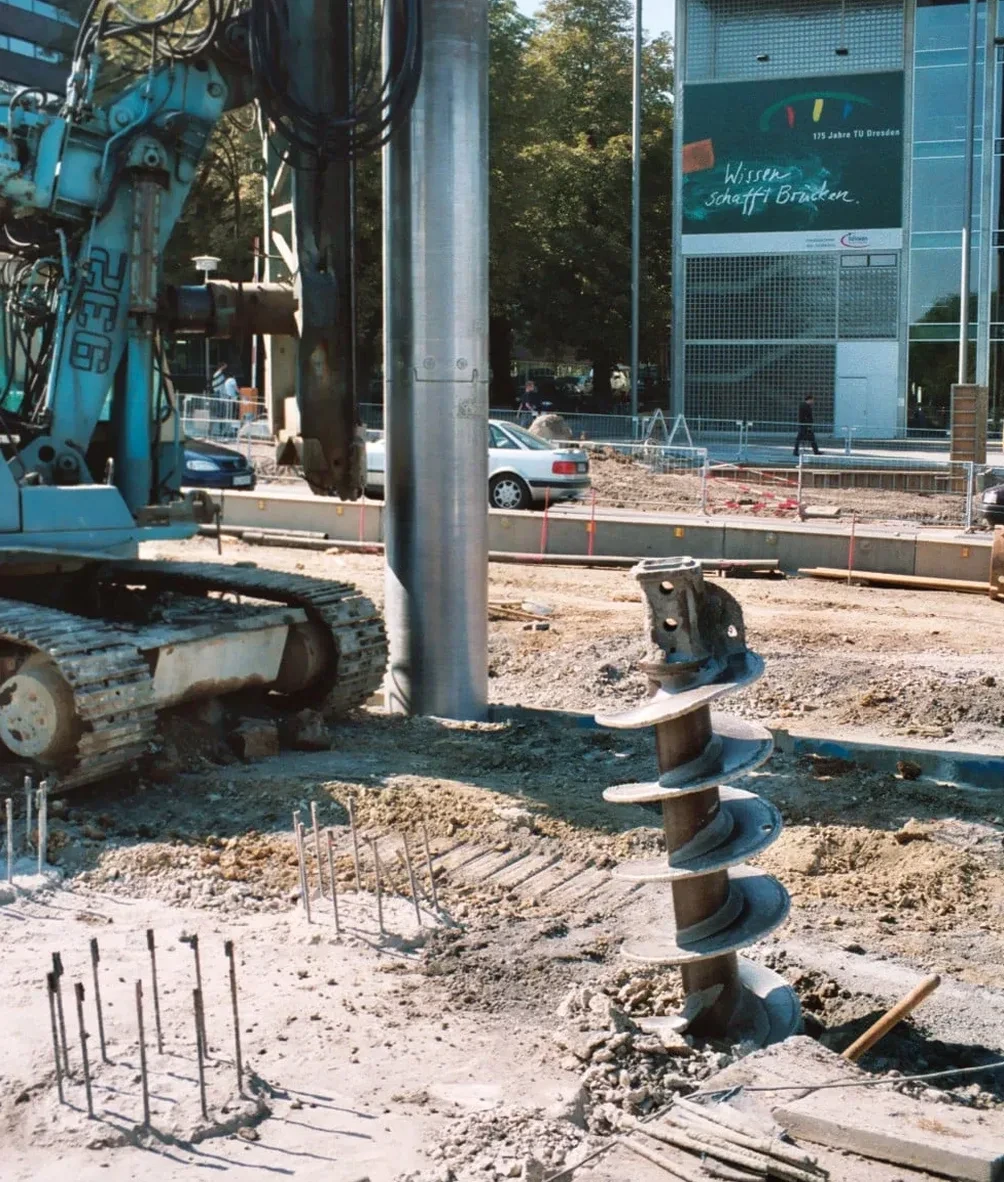
For sites with limited headroom, vibration restrictions near historic masonry, or refusal depths beyond practical driving lengths, we design drilled shafts or ACIP piles that socket into decomposed Piedmont rock. Construction-phase QA includes cross-hole sonic logging per ASTM D6760 and thermal integrity profiling to verify shaft continuity.
Quick answers
What does pile foundation design typically cost for a DC townhouse or rowhouse project?
For a single residential lot in neighborhoods like Capitol Hill or Petworth, a complete pile foundation design package—including geotechnical borings, lab testing, structural design for 4–8 micropiles or driven H-piles, and a stamped PE submittal for DCRA—generally runs between US$1,780 and US$5,390 depending on access constraints and the number of borings required to satisfy the 50-foot spacing rule under IBC 1803.3.1.
How deep do piles need to go in Washington DC to reach competent bearing?
It depends entirely on which side of the Fall Line you’re on. In the Piedmont portion of Northwest DC, decomposed schist and gneiss can appear at 15 to 30 feet, and piles often socket 5 to 10 feet into weathered rock. East of the Anacostia, in the Coastal Plain, competent bearing in the Potomac Group sands or underlying crystalline basement may be 60 to 100-plus feet deep. We determine the exact refusal depth through SPT borings that extend at least 20 feet below the deepest pile tip per IBC 1803.5.5.
Do DC building code reviewers require a static load test for pile foundations?
IBC 2024 Section 1810.3.3.1 requires that at least one pile per site be load-tested when the design capacity exceeds 100 tons or when the site falls within Site Class D, E, or F—which covers much of the District’s Coastal Plain. In practice, DCRA plan reviewers consistently request either a static load test (ASTM D1143) or a high-strain dynamic test with CAPWAP signal matching, and we include that specification in every design package to avoid a stop-work order during foundation inspection.