The geology under Washington DC shifts dramatically as you move from the crystalline bedrock of Upper Northwest near Rock Creek Park toward the deep alluvial and artificial fill deposits along the Anacostia River corridor in Navy Yard. A foundation design that works perfectly in Tenleytown can encounter compressible, undocumented urban fill just four miles southeast in Buzzard Point. Our vibrocompaction design service targets these contrasts directly, verifying that proposed ground improvement will actually densify the specific sands and silty sands found at the project depth. We combine pre-design site characterization with CPT testing to profile the target stratum, then specify the vibroflot grid, energy input, and a verification program tied to ASTM standards and IBC Chapter 18 acceptance criteria.
Effective vibrocompaction in DC means designing around the fines content, not just the relative density target.
Technical details of the service in Washington DC
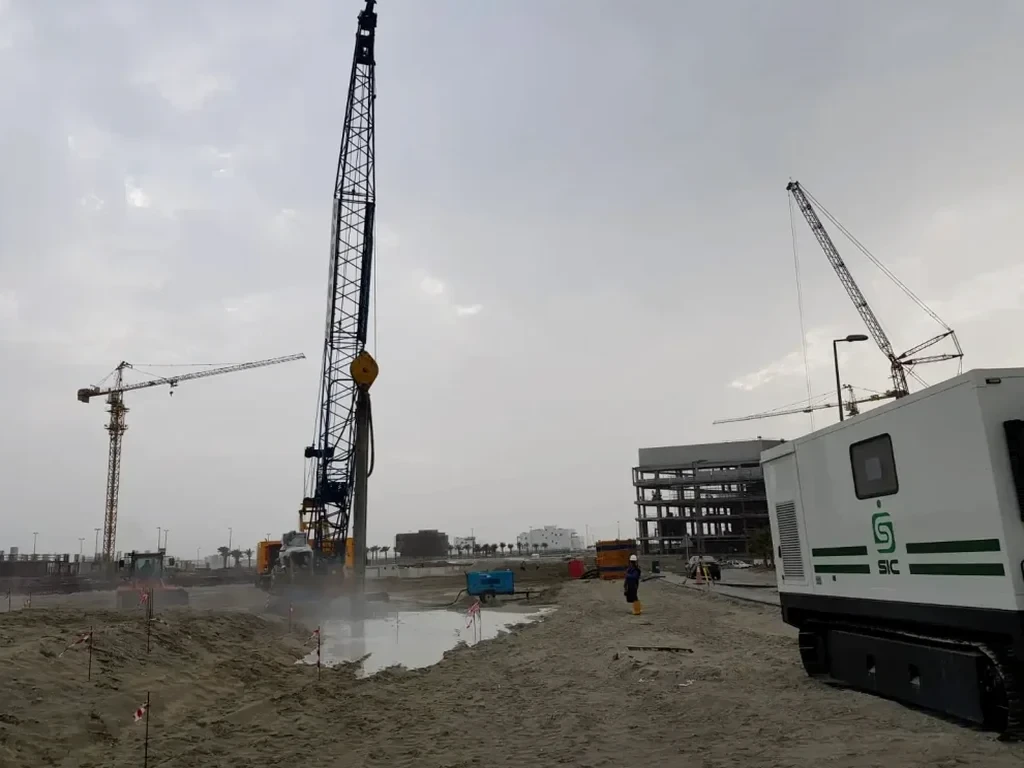
Field demonstration
Risks and considerations in Washington DC
In our experience on sites along the former Tiber Creek alignment and in areas of the old Washington City Canal, we frequently encounter buried organic silt lenses that are invisible on a standard geotechnical boring log if the sampling interval was too wide. When vibrocompaction is applied over these pockets without recognizing them, the organic material simply churns and does not densify, leaving a soft spot that can cause differential settlement under a mat foundation later. We mitigate this by running a high-resolution CPT sounding at the center of each vibrocompaction cell before mobilization. The design also accounts for the proximity of Metro tunnels and century-old brick utilities, where vibration must be limited. We have adapted designs in Penn Quarter and Capitol Riverfront where the vibroflot had to work inside a 25-foot setback from a WMATA tunnel easement, using a smaller probe and reduced energy, with continuous vibration monitoring.
Our services
Our vibrocompaction design work in Washington DC is structured around three core technical deliverables that take a project from feasibility through construction verification.
Pre-Design Soil Characterization
We direct the subsurface investigation specifically for vibrocompaction assessment, specifying CPT soundings and sampling intervals that capture thin silt layers and the fines content of the target sand. This phase determines whether the ground is actually treatable by depth vibration.
Vibrocompaction Specification Package
A sealed design package including the probe layout, energy parameters, real-time monitoring criteria, and post-treatment acceptance values. It serves as the technical basis for the specialty contractor's method statement and the special inspector's verification plan.
Post-Treatment Verification and Sign-Off
We design and oversee the verification testing program—SPT borings, additional CPTs, and surface settlement surveys—and issue a letter of conformance stating that the achieved density meets the IBC and project specification requirements.
Quick answers
What does vibrocompaction design cost for a Washington DC project?
For a typical commercial or multifamily site in DC, the vibrocompaction design fee ranges from US$1,330 to US$5,180, depending on the treatment area size, the number of CPT soundings we need to review, and whether a test section program is required. This covers the specification package, pre-design analysis, and post-treatment verification reporting.
How do you confirm that vibrocompaction actually worked?
We specify a combination of pre- and post-treatment SPT borings (ASTM D1586) or CPT soundings (ASTM D5778) at the same locations, and compare the measured tip resistance or N-values. We also monitor surface settlement across a grid of markers during compaction. The acceptance criteria are tied to a minimum relative density, usually 70 percent or higher.
Is vibrocompaction safe to use next to existing buildings in DC?
It depends on the distance and the building condition. We evaluate the peak particle velocity attenuation using field data from the test section and set exclusion zones. Within about 25 feet of a sensitive structure or a WMATA tunnel, we often switch to a lower-energy probe or specify an alternative like stone columns if vibration risks cannot be managed.
What soil conditions rule out vibrocompaction?
If the fines content of the target layer exceeds 15 to 20 percent, or if there are thick organic silt lenses, vibrocompaction generally cannot achieve the required density. In those cases, we may recommend a different ground improvement method such as rigid inclusions or removal and replacement, depending on the depth and groundwater conditions.